Episode Transcript
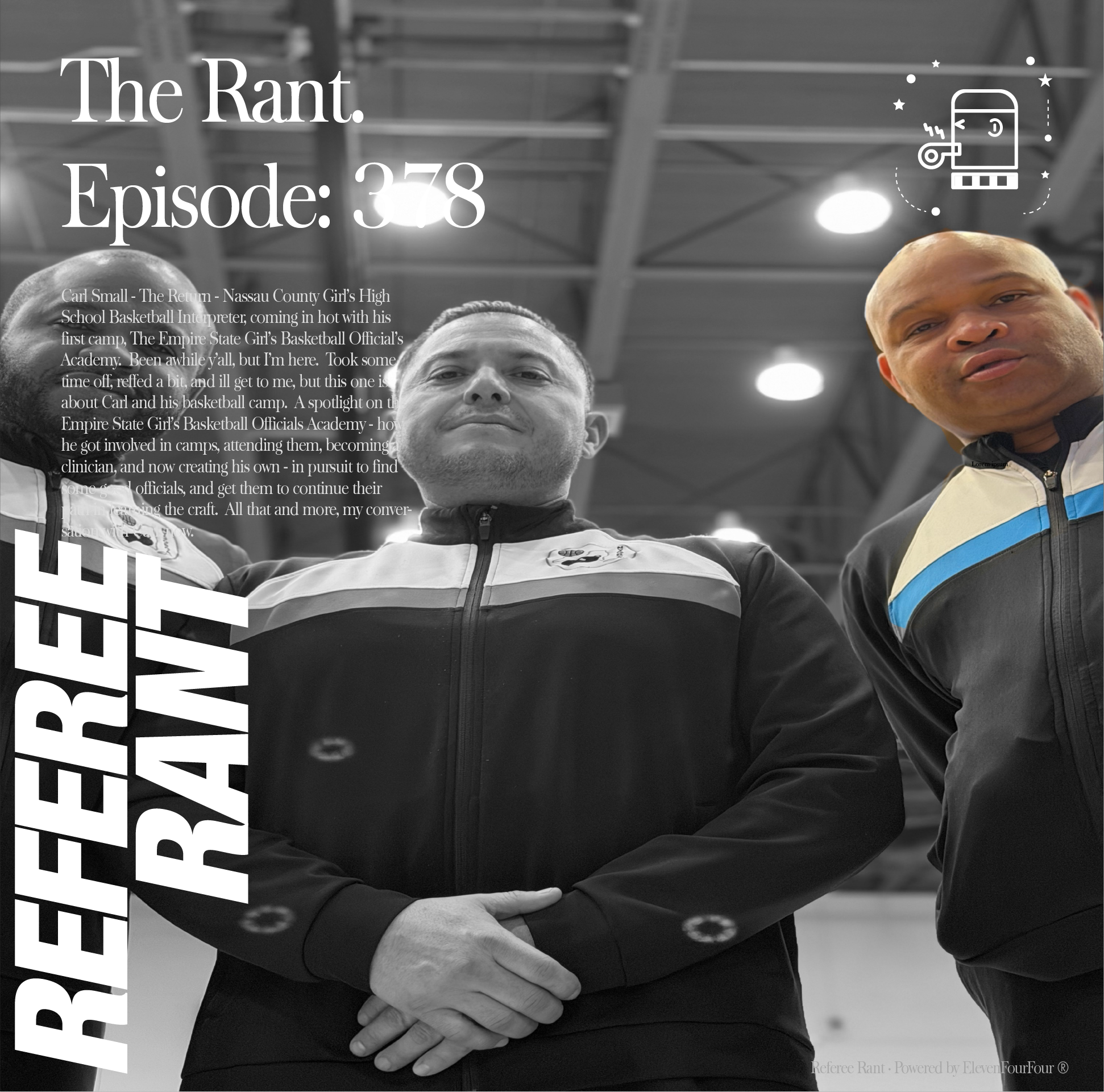
[00:00:14] Speaker A: Episode 378 the Rant Carl Small, the return.
Nassau Girls High School basketball interpreter, coming in hot with his first officiating camp, the Empire State Girls Basketball Officials Academy.
Been a while, y', all, but I'm here. Took some time off reft a bit and we'll get back to me. But this one is about Carl and his basketball camp. A spotlight on the Empire State Girls Basketball Officials Academy, how he got involved in camps, attending them, becoming a clinician, and now creating his own in pursuit to find some good officials and get them to continue their path in learning the craft. All that and more. My conversation with Carl Small now.
[00:01:22] Speaker B: 3, 11, Eight. 3, 11, 3, 11, 1, 3, 4, 5, 6, 7, 8, 9, 10, 11, 12,
[00:02:05] Speaker A: Two,
[00:02:12] Speaker B: Four.
[00:02:18] Speaker C: Referee Rant 2.0. I'm your host, Ralph the Ref. I'm with one of my best friends in the officiating space, specifically in basketball. I have the NBW BOA interpreter for girls high school basketball in Nassau county, as well as a accomplished high school and Division 2, Division 3 juco official in basketball, Mr. Carl Small. How are you, my friend?
[00:02:40] Speaker B: Excellent. How are you, sir?
[00:02:41] Speaker C: I'm doing pretty good. This has been a long time in the making. I've been trying to get you. I don't know how many days, I think if I scroll through my phone of how many times I was trying to get you. I'm just really happy that I got you on because you're in the midst of trying to sort out and finalize the Empire State Girls Basketball Officials Academy, which is going to be run on June 30, 2026, and July 2, 2026 in New Hyde Park, New York, which is in Long Island. And then July 6th, 7th and 8th, right after 4th of July in Freeport High School. Congratulations to you on setting up that camp. I'm very interested in the machinations of how camp goes when you're on the admin side and trying to create it out of scratch. I know you and I have attended several camps previously when we first started. That's kind of how we got to know each other and realized that, you know, you're one of the people that wanted to take it seriously. And then as, you know, years go on, you start becoming a clinician in some of these camps.
You still dabble in certain camps that you're trying to get hired to. And there's a tryout and maybe we'll. We'll go through the differences between them because I think some officials, especially like, when they start off, they're Not. They don't know what's going on with. With the differences and how you need to suss out all this information. But let's go start with everything with you, man.
You know, we're taping this on June 23, 2026, which is a Tuesday morning.
How much officiating have you done since the season has ended?
[00:04:16] Speaker B: Not much. Few rec leagues here and there, men's league and stuff like that.
You know, I tried. I tried to kind of turn it down a little bit when the season's over, because I'm so busy during the season that I don't get time with my family and friends and stuff like that. So, you know, from.
From November till about March, it's. It's on and popping, and then March to October, take a break.
My kids are very athletic. They play different sports. So, you know, I like to be around for that.
[00:04:50] Speaker C: So do you feel like. Because I know that this was a thing for me when I first started, I felt like I would lose my edge if I wasn't continuously officiating, whether for whatever, what sport it is.
Do you think that, like, what. What year would you say where you started, not worrying about, like, oh, I don't need to get reps, and not that to say it's not important, but just more so the. I guess the mental health part of it and just feeling fresh for the season as opposed to just grinding, grinding, grinding, and then it's kind of blurring in when you're already starting the season.
[00:05:25] Speaker B: Several years ago, maybe around 2016, 2017, where I was like, you know what?
It wasn't about not getting the reps. It's just about. It was about. It was more about what. What I was missing when I was getting those reps and, you know, doing eight to ten games a weekend and, you know, feeling exhausted and, you know, just not being around my family. So, you know, I.
I'm constantly thinking about it.
I always have to be sharp, especially as the interpreter, because even. Even in the off season, you know, people reach out and. And ask questions.
I'm part of several different chat groups that stay active. You know, we find plays on the Internet and stuff like that, and we share them and we talk about rules and stuff. So even though I'm not physically working, the mental game is constantly going. And, you know, as the interpreter, I teach the class, so I'm constantly thinking about that, what I can do better, how can I improve it.
I try to make the class fun, interesting, as well as educational.
For those who are taking it because we need more officials.
In every sport, there's a shortage of officials. And those who are willing to put on the stripes, I want to make sure to teach them the right way.
[00:06:42] Speaker C: Yeah, I think this is like a never ending quest for us to get more people like ourselves to, to take up the advocation that we do. And it's just very difficult. I just know that we've all tried different things. I know over the course of many years, I'd go to a McDonald's, I'll see like a young kid and I'll say, how much are you making? They'll tell me $15. I'll scoff at that, say, you can make triple the amount until they come and see me and get enthusiastically yelled at. And to the point where, you know, I'm really impervious to it, but it seems like it discourages people. So I guess the question that I wanted to ask for you is when you're in, I guess, the thick of just your life, right, just watching your kids play baseball, you're officiating, whether it be a rec game or a school game, how do you even go about trying to convince somebody to take up officiating? Like, how does that. Because I know that's also important to you to try to give back, especially when people are in it. But what is, what is the starting conversation that you have with somebody that knows nothing of nothing?
[00:07:49] Speaker B: Well, it's kind of like you said, and you use a great term, enthusiast, enthusiastically yelled at.
And you know, I speak at a lot of basketball camps for, you know, that kids go to and stuff like that. Some people haven't come down and speak as an official and as, you know, share the rules and share rules knowledge with the players. And one of the first questions I ask is, you know, one of the first things I always say is, why not officiate? It's a great way to stay connected to the game.
You know, every kid that plays basketball or whatever sport, they think they're going to go pro automatically.
And I always tell them, probably not gonna happen, you know, because there's such a small percentage, there's a small. There's such a great number of kids that play high school sports.
That number dramatically drops when it goes into college, and then it drops even more when it goes into the professional aspect of sports.
So, you know, the one thing I say is, hey, it's a great way to stay connected to the game.
A lot of kids say, no, I want to coach.
Well, then you have to deal with different personalities. You have to deal with parents, you have to deal with kids. You have to, you know, run practices and stuff like that. As an official, you don't have to do stuff like that. Right? We show up to the game, we work, we go home. We don't have to talk to parents, we don't have to talk to kids. We don't have to be, lack of a better term, a psychologist. When a kid is mentally breaking down in a court, that's, you know, the coach's problem.
But one of the things that I also mention is, is that the financial aspect of it, you know, there's, there's people in the highest levels. That's all they do from, from November to March, they just officiate basketball on the highest levels and they make good money. I mean, some of the Division 1 officials are making upwards of $4,000 a game, depending on the conference. I mean, and you have these people doing 100 games, you know, do the math. 4,000 times 100, that's $400,000 in your pocket for six months of work.
You know, so that's, that's kind of where kind of like what you mentioned, when you see the kid working at McDonald's making 15 to $18 an hour, you know, that's how my friend got me into it. I used to be in catering, making 10 to $12 an hour. My friend asked me one day, he said, how long does it take you to make a hundred dollars? 10 to $12 an hour after taxes, you know, 10 to 12 hours, you know, full weekend's work.
And he kind of laughed and he said, I can do that in an hour. And I said, how? And he said, well, varsity games pay 100, something dollars a game at the time.
He said, or I can do three rec league games for 30, 40 hours a game and walk out with $120 cash.
So that's kind of what opened my eyes. And, you know, that's kind of what most people see when they first start officiating is the money.
And then once you start enjoying it and learning it and learning how to do it the right way, you end up falling in love with it.
[00:10:45] Speaker C: Absolutely. And I feel like both of us have, are living proof that we're a testament to the reason why we're living it right. We're living it almost every day. Something that we always, I know that a lot of our conversations obviously spill to normal life, but, you know, the last probably hundred touch points that I've had with you in terms of texting you, calling you, have been centered around this camp that you just started. And I feel like it's been a labor of love because this is something that you've always kind of, like, had in the ether, Something that you've always wanted to set up. So I'm very interested how you came up to the conclusion of starting this camp, Starting with, I guess, your own experiences attending camp and then being a clinician. Let's just talk about, like, I guess, your journey, participating in camp. I know I'll even share my own first camp experience. I think that was the first time, like, you became, like, a clinician for Magbo or something. But I just remember it was me and Michael Grant, and we're out there, and then I feel like, what's his name? Jim. He's like, we're gonna. We're gonna have three refs. And me and Mike were looking at each other like, no, let's make it two. I don't know how to do that. And then I just remember thinking, wow, I just spent $250 or something that somebody was telling me that I could have done. But that was the tax I needed in order for me to learn that I needed to learn more. Right, Right. So that's where I was at. And, you know, we talked about this offline. We talk about this eternally about just running your own race, right? Refereeing is a very specific thing where it's like, you have teammates, but at the same time, you're also running your own race. And it's, like, really hard to articulate that until you're in it, because you're still competing with the same people that you're working with all the time, and you might be having the same game, right? And then, as you said, too, where it. Where there's, you know, precipitous, a lesser concentrated amount of officials. When you go from rec to high school to college to pros, right? Let's keep it in perspective. In the pros, let's. Let's just say the NBA, there's only 350 players, right? So if there's 32 games and then everyone's playing at the same time, there's 16 games going on. Because, you know, it's not just one team. There's only three refs on one game, right? So there's already even a smaller pool because the team consists of normally 15 athletes. Five people play on at the same time. There's only three refs on the court. So you already know at the professional level, they're just not picking a lot of people. But let's just talk about your journey. When you first started camp. What year was it when you first started attending a camp?
[00:13:18] Speaker B: First year I started officiating.
2011, I took the class, the Diabo class, for board 41 for boys basketball in New York State.
The instructor, Don Lundolphi, mentioned that the iable, the International association of Approved Basketball Officials, held a camp every year at Rutgers University.
And I was like, wait, there's somewhere where we can go and practice to get better.
And Don was like, yeah, it's called camp.
And he said, he was like, just like players go to camp to learn and improve, and teams go to camp to learn and improve, get better. He said, we do the same thing.
So right. Right out the gate. Right out of the gate. 2011, after I passed the class.
At that time, when you passed the class, you didn't work for at least a year.
You couldn't start working until the following year. You couldn't start doing your junior high games until the following year. So it was like taking the class. Now again, I was lucky enough to have some people in my corner who put me on a path to help me learn and get better. In my first six or seven months of officiating, I was going back and forth to New York City, pretty much going to a camp, per se, but I was working live games for free.
And they were, you know, veteran officials on the sideline who were observing. And, you know, we would come off the court and they would have a page, one of those big yellow pads, and it would be a page full of notes of, why did you do this? Why didn't you do that? You had this play, you missed this play. You did that very well. You did this very well, you know, giving, you know, constructive criticism to help me improve.
And as the time went on, the notes got smaller and smaller and smaller and smaller to a point where it was like, not that I knew everything, I was doing everything right, but I was improving and showed. So that same summer, I did sign up for the IABO camp at Rutgers. It was run by Donny Epley and Tom Lopes.
Great experience.
They threw me right in the fire. Every game was three person. Luckily, I was doing some three person while I was going back and forth to the city. So I had a pretty good foundation regarding the three person system.
And from there on, I just absolutely loved it. And again, the relationships that I've made going to the camps, the people that I saw going to the camps, a lot of those people I still talk to to this day, or I See this day, working games with them, college, high school, and sometimes, you know, beyond rec leagues and stu like that.
So, you know, a lot of people speak bad about camps because they say, oh, it's a ripoff. People are just trying to money grab. It's this, that and the third.
And to an extent, there are camps like that.
But camp is going to be what you make of it. If you go there and you're willing to listen and learn, you're going to learn and you're going to improve.
And again, that aspect of me being in that class that very first day, I always said I wanted to teach. When I started to hear about camps, I said, hey, you know what? One day I want to run a camp.
And like you said, I had the opportunity to be a clinician at a couple of camps, which was very satisfying to help others learn, grow and improve. And, you know, it was always just in the back of my head. One day I'm going to have my own camp and here we are, week away.
[00:16:57] Speaker C: So going back to that clinician part, I know when I got chosen for whatever camp to observe, I still kind of find it weird because, I don't know, sometimes people don't really think that I'm a serious person.
So, you know, just the fact that you stuck long enough for you to be able to feel as though that you're an expert and you can articulate, I think that's also a more important thing, to convey certain messages to people, people when they're at a certain point. I think that's a very important thing because there's a lot of really great refs that can't really convey what they do. And then there's a lot of people that can articulate very well, but aren't really good refs.
[00:17:34] Speaker B: Right.
[00:17:35] Speaker C: So when you have that combination that's able to communicate effectively with the general population, that's a plus. What was the first time that you became a clinician and how did you feel about that? Did you feel.
I don't know. Where did your mind go with. With that information?
[00:17:50] Speaker B: It was.
It was with an organization, unfortunately, that's no longer around.
Magbo, Kerry Donahue and Jim Gorillo.
They initially I was. They. They had a class which was an instructional class to help teach officials, and they were having a camp and they asked me to be a clinician and I was very excited and I was so happy because again, it was on the bucket list. It was a goal that I wanted to achieve and I was lucky enough to be involved with them. And they took me on. So it was very exciting to help out those officials that wanted to come to camp and learn. And it just felt it was very satisfying.
[00:18:46] Speaker C: So having that experience with attending camp and then having the experience attending camp as a person that is observing other fellow officials and now that not only are they your peers, you're somebody that also was an expert at the subject matter in which they are trying to also become an expert at the subject matter. I would imagine that those are the building blocks and foundations of you coming up with the camp that we're. That's coming up in almost a week.
Tell me how that started about. You were obviously kicking the tires for years and years, but when. Why was it 20, 26? Like, you know, what effort? I'm gonna do it this year. I'm gonna really make it happen. How did that all come about?
[00:19:27] Speaker B: Something I've been trying to figure out for a very long time.
You know, just. Just to give back to the game.
Last year, you know, last year was actually the first camp that I did.
We did it through.
We initially ran it through our board, the NBW BOA organization, and it was just strictly for those officials.
We had a pretty good turnout. We got some great feedback as far as how we did.
And you know, after that this year I just decided, you know what, I still have the, you know, the, the person who assigns the tournament, Ernie Rudloff, he, he helped out a lot and, and speaking to the people that actually run the leagues to allow us to do this, so greatly appreciate that.
And you know, this year we decided that.
Well, I kind of made the decision that, you know what, we're just gonna, we're just gonna kind of blow everything up and just go on our own and see how it fares to see if we can help those who want to get better in this application, better at the three person system.
And that's more what it's about. It's about helping those officials who aren't comfortable in three person become more comfortable and more proficient.
You're kicking around the word expert a few times. I wouldn't say I'm an expert.
Very knowledgeable. Obviously I care about this avocation. I care about what I do.
And I just want to share that give back and hopefully get people who care as much as I do so that we can, you know, all improve and grow together.
[00:21:13] Speaker C: Shout out to Coach Jones at Freeport High School and shout out to Coach Bello of New Hyde Park High School for allowing the opportunity to have this camp.
I know that it's going to be worthwhile. I'm going to be involved, I think I'm going to go July 7th and 8th, hopefully to observe some of the officials as my capacity as a fellow official and as the president of the association NBW boa. So I'm really interested and excited to have the opportunity. So I want to thank you guys for my participation in it. I did want to touch upon the venerable Ernie Rudloff who has been ubiquitous in terms of helping me as a mentor, as a friend, as a fellow official. He just finished his 40 year post in Odyssey as the interpreter of Ward 119 of Aabo boys basketball officiating. And somehow he's still a Wiley Fox, still involved in all things officiating. Absolutely. What was it like working with him and collaborating with him in setting up this camp?
[00:22:14] Speaker B: Ernie's great.
You know, he kind of just gave me the reins and said, you know, go, you know, just keep me in the loop.
You know, you, you know, I, I pitched my idea to him and you know, I don't want to say there was a little bit of kickback, but he just wasn't sure if everything that I was thinking would happen, which is fine. And, and he spoke to the coaches, Coach Jones and Coach Bello, and they were more than willing to accommodate us to, to, to have this camp, you know, get off its feet and, and do what we needed to do to help these officials that want to attend get better. So it's, it's great working with Ernie.
You know, I, it's, if it wasn't for him, I wouldn't have this opportunity.
You know, two, two years ago I approached him about it and he said it's a great idea. And you know, like I said, we did a small little, I guess, beta test last year, was doing it through the board and now this year we're, you know, we're inviting everybody.
[00:23:18] Speaker C: Yeah, I'm very interested on how it's going to go.
What can people that have already signed up and are about to sign up, what can they expect from the camp?
[00:23:28] Speaker B: It's going to be a great experience.
We have a number of great observers, high level college officials, high level high school officials.
Myself, I would also like to announce and I greatly appreciate her time. Stephanie Barksdale will be at New Hyde park on the 30th and the 2nd.
Very excited about that. She's one of the best officials in this area. She's a pro official, she's a high level college official and just over overall, she's a Great person.
I remember when I first started, I went to a camp in Pennsylvania at Kutztown University, and she was on her way up. She was the IT official at the time.
And I was lucky enough to be able to work with her. And I mean, even then, seeing her work, it drove me to get better because, I mean, every game she was on, every college coordinator would watch the game, Every single one that were at the camps, just about some clinicians would leave their courts and come watch her work.
[00:24:43] Speaker C: They didn't do that for you?
[00:24:44] Speaker B: And no.
So I guess it didn't drive me that much. But, you know, I mean, there was a point in time.
I don't want to say I was the IT official, but, you know, I remember attending a camp at St. John's it was Cornell Hampton's camp, and I was told that there were a few college coordinators there. I was told by one of the clinicians, actually a couple of clinicians, Randall, Amy and Bernard Meyer, that my name was, you know, being whispered a lot throughout the camp. My name was being mentioned. People were talking about me and I was, I was, you know, I was humbled, I was surprised.
And it panned out. I did get hired by two coordinators based off of my work at that camp. So it was very satisfying to see that my hard work was paying off.
So, you know, I'm just, you know, getting back to the camp and getting back to Stephanie. We're just super excited that she's going to be there. She's just going to bring another level of officiating knowledge to, to this camp. And, you know, those who are lucky enough to be there at those two dates are, you're. You're definitely going to be in for a treat, you know, having Stephanie as an observer.
[00:26:05] Speaker C: Yeah. And I'll just say my own personal experience with Stephanie. I've also seen her at a camp setting. She went to that first camp that we were talking about previously. And I just remember, who is this tall young lady that just sounds like she just knows what she's doing? She has a very commanding presence. Obviously, I've seen her officiate, you know, the G League. I've also seen her ref at Pro City a couple of summers ago, which, you know, I just really thought that her prep, her presence is just like Super A1. Her communication style is A1. But one thing that always stuck out with me when I had an off the record conversation with her about, you know, just being present where you're at, being happy with where you're at, being Try to be in great at the level where you're at, where, you know, I think this is a never ending struggle for an official that's trying, that's on the ascent where they're already focused, their, their eyes are not necessarily on what's in front of them and they're, they're constantly looking at what, what's the next rung, what's the next step? What do I need to do? Where it's like we're not really enjoying the process. And I think as time goes on, you realize, especially when you get to the stature of somebody like you and I, where we're very already successful at what we do, it's more important to stay where you are as opposed to just worrying about where you're not.
[00:27:28] Speaker B: The saying goes, it's better, better to be a year late than a year early.
Because if you're, if you're a year early and you're not ready for the level that, you know, you quote, unquote want to get to you youu know, sugar, honey, iced tea, the bed, then you're not going to be welcome back. Whereas if you're yearly, people are gonna be like, whoa, where were you at? Where were you at? Why didn't, why didn't we find you sooner?
[00:27:55] Speaker C: Right?
[00:27:55] Speaker B: Because that's what it is. And especially for those who want to get to college. It's not, it's not, it's not about you, it's about them finding you. If I can, if I can word it that way, it's not about you getting there. Like a lot of people. You know, as Ralph mentioned, I do women's college basketball on the D2, D3 and juco level.
I'm not gonna lie. I was chasing the men's side for many, many, many years. It just didn't pan out. And the women's side chose me. And I'm very happy with that choice and that decision.
I'm actually glad that I'm women's. I, I definitely prefer the game, believe it or not, over the men's game.
[00:28:39] Speaker C: And I don't know if you agree with me on this, but I feel like the, the feeling of urgency has been different. Especially like post pandemic of the refereeing world. For me, I know that I would go anywhere. I'd go to Connecticut, I'd go to Maryland. I'll go anywhere for a game. I'll go to Westchester, I'll leave my house six hours early for a game that's happening at, you know, apm. And I'm sure, you were doing the same as well. But I feel as though at this point in my career, I feel more important that it's not necessarily like a Broadway play where you audition to be on Broadway. Right. And I feel like sometimes in the beginning you're so shell shocked of like, how many ways this can go that you are auditioning for somebody, you're hoping that they can choose you, but then you realize as time goes on, when you were having that analogy, better, better late one year than being at the party too early. You know, if you go to that audition super early, you're blocking your blessings for a long time. Right. It's just really hard to recover because there's some certain things that you have to clean up. But if you remove any doubt that you belong there and that it seems like you should have belonged there anyway, I, I feel like that's a better, better way. But going back to your camp, I. It's going to be a mixture of people that have already belonged and also people that are new. Right. How are we going to meld those two worlds together of people at different levels of officiating? Are you going to perfectly product place specific officials to anchor certain crews or.
[00:30:07] Speaker B: No, no. Everybody. It's. There's definitely.
Based off of the registration forms, there's definitely a various level of.
What's the word I'm looking for?
Experience. Damn. Wow.
There's, you know, from, from college down to, you know, brand new, brand spanking new first year out of the, out of the class. You know, never did three person before, and everyone's just gonna work together and, and that's, that's more or less how it is. You know, Ralph and I were talking earlier and you know, I mentioned, you know, a lot of times I still go to camps myself. You know, I just had a camp two or three weeks ago that I went to and there, there were a number of officials that, you know, not, are not even on the college level.
Right. And me, as, as an experienced official, I'm. I'm there to help them. So, you know, that's, that's what I'm hoping for.
The, the more experienced officials to, you know, obviously the clinicians will be there, the observers will be there to help and, and support the newer officials.
But the veteran officials, like, obviously we can't run in the court and be like, stand here.
So the veteran officials that people are working with, you know, they'll, they'll kind of help out, give a little head nod. Hey, you're supposed to go there. You're supposed to do that.
So that's what we're hoping for.
But it's, it's going to be a good experience for everybody. You're. You're definitely going to walk away learning something that you didn't know before.
[00:31:37] Speaker C: Yeah. And I would imagine that, you know, especially when you have all of these people with wealth of information. I know for me, I'm very promiscuous when it comes to like learning. You can learn in an audiobook, you can learn in a book. You can learn on something that you just heard from Twitter or TikTok or whatever.
[00:31:52] Speaker B: Right.
[00:31:53] Speaker C: Never feel as though information can't come from anywhere at any time. And I definitely think that the conditions that there will be at the Empire State Girls Basketball Officials Academy will have that feel.
How can people find out more information? And do you still have a lot of slots left? I know they're filling fast.
[00:32:12] Speaker B: We can definitely take a few more people.
You can reach out to me directly.
There's been a lot of advertisements on. On. On Facebook.
My. My email address.
C small inter. So c s m a l l interp I n t e r p gmail.com again, c small C S M A L L.
Interp. Sorry interp mail.com.
not going to give out my direct phone number on here, but best way to be. Best thing to do would be is. Is to email.
We can definitely take on a few more people. It's very affordable. 125 gets you two days of camp, guaranteed two games.
And it's just going to be a strictly learning environment.
I have invited a few college coordinators. They haven't really confirmed yet, but again, I can't guarantee someone's going to get hired. I can't guarantee someone's going to get picked up or, you know, moved on to college. We are strictly an educational opportunity.
[00:33:26] Speaker C: Right. And as we're both living proof, I mean, again, you can never stop learning. I mean, I've been coaching volleyball for 30 years and I still feel like I don't know anything. I don't even know how I became all the success that I had in volleyball. And the same thing goes for officiating. But, you know, I'm never going to be below learning and I'm never going to be below trying to be better than what I was previously.
[00:33:48] Speaker B: Right.
[00:33:49] Speaker C: So we'll also attach the flyer and then the link to the description of. Of your camp. So then that way we can get some of those few stragglers, maybe other people that could sign up. Any final words? You want to say before we part.
[00:34:06] Speaker B: Just keep growing, keep learning, keep improving.
The second that you think you know it all, that's when something's going to hit the fan and you're going to realize that you don't know it all.
You know, get a mentor, get somebody you trust as an official and, you know, keep the good stuff. Whatever good information you're getting, make sure you keep. If you're getting bad information, obviously, you know, in one ear and out the other, don't be that. Yeah, but person. If someone tells you you did something wrong, don't say, yeah, but. Because then that makes you look like you know everything already.
And just if you love it, continue to do it.
And, you know, be that. Be that. Be the best official on whatever level that you can be.
That's it, more or less.
[00:35:01] Speaker C: And on behalf of NBW boa, we appreciate you being the interpreter. I know that's probably a very difficult job.
It's a big undertaking. I know that you have help with Joe Dooley and Fabian, so just keep doing the good work.
I'll try to always throw you guys, and hopefully we'll get even more people with your camp and, you know, as time goes on, hopefully it'll be a successful yearly thing. Appreciate you, man.
[00:35:27] Speaker B: Appreciate you more. Thanks, bro.
[00:35:28] Speaker C: Carl Small, Ralph, the ref. We out of here.
[00:35:30] Speaker B: This is referee Rain. Peace.